






Hanko — Japanese Signature Seals
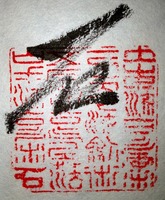
by Steve WeissThere comes a time in the life of an instructor when you are faced with the task of issuing menkyo (rank certificates) to your students. One of the essentials pertaining to this job is the proper use of hanko (seals). The first thing you must do is of course find a qualified seal carver to make the actual seals for you. At this point you will probably wish to have at least three sea...
Read More!Deshi
by Lynn ReafsnyderMost of us have used the word deshi, often without any real understanding of just what the term means. Many of us hearing the word think of the usual, poor translation of “student,” but the word really means something much more. In Japanese, the term for student is gakusei and the term for disciple is deshi. There is a difference.Let’s take a look at the kanji ...
Read More!Lessons from the Gorin no Sho
by Robert WolfeIntroductionThe following article has a very long history. It was originally written in 1977 as a paper for a college course examining Japan from the perspective of cultural anthropology. In 1981, it was accepted for publication in The Bujin, and it became my first writing credit. A reworked version later appeared in the second issue of the Journal of Asian Martial Arts, in 1992. I...
Read More!Conditioning Exercises for the Abdominals
by Robert Wolfe / Illustration by Rosanne Wolfe“The serpent in the stomach.” For centuries, martial arts instructors have used this colorful metaphor to describe the source of muscle power for most traditional techniques.Working in concert, the muscles of the hips and abdominal region produce the torque that drives cuts, strikes, and throws. Most people today train their midsections f...
Read More!Capturing the Absolute Moment
by Okabayashi Shogen It is very hard to express aikijujutsu in words, but I will give it my best effort. I expect that all of you reading this want to become stronger, but have you ever considered exactly how strong is strong enough? Is it enough to be the strongest in your neighborhood? Or would you like to be the strongest in your city or state? Perhaps strongest in the country? &nbs...
Read More!Myths of Self-defense
by Robert WolfeMany people seeking martial arts training cite gaining the ability to defend themselves as their primary motivation, while almost everyone seeking training includes “self-defense” capability somewhere in their list of goals. Persons training long-term typically come to recognize a wide range of benefits far exceeding in everyday utility the value of being able to fight ...
Read More!Reasons to Choose Itten Dojo
Here are a few of the many, excellent reasons to choose Itten Dojo:• You will be a member, not a customer (we do not use contracts).• You will train in authentic, heritage martial arts with fully documented lineages tracing directly to Japan.• You will have regular access to some of the most-accomplished, highest-ranking instructors in the world.• Our dojo is widely recognized...
Read More!Knees, Feet, and Ground — the Critical Interface
The knees are some of the most critical, and also most vulnerable, joints in the human body. Protecting the knees in routine training is a primary requirement for long-term participation in martial arts. Equally important, the things a student should do to protect his or her knees can be a gateway to learning how to optimize the power and effectiveness of a wide variety of techniques, regardless ...
Read More!Self Defense Law and the Martial Artist
by Vigiles UrbaniIntroductionAnthony Ervin was a career criminal. He was arrested eight times on assorted robbery, weapons, and assault charges between 1987 and 1996. On October 8, 1996, he accosted Courtney Beswick, a blind man who must have seemed like an easy target. After Ervin’s demands for money were repeatedly refused, he attacked Beswick. Beswick, a long-time practitioner of martial...
Read More!The Last Bugeisha
by Peter HobartWith due respect to Robert Fulghum, almost everything I know, I learned as a bartender: • Welcome everyone through the door, but be ready to show it to them again if need be. • Treat a pauper like a princess, and a princess like a pauper. • There isn’t much that men (and women) of good f...
Read More!No Toy Swordsmen (or Swordswomen)
“Toy swords make toy swordsmen” was an oft-heard litany in the style of swordsmanship we trained in for many years, over the course of two separate periods of time. For simplicity, I’ll refer to this former study of swordsmanship as the “legacy style.” The “toy swords” phrase was intentionally disparaging of anyone training with an iaito (an alloy-bladed,...
Read More!Judo Study Group
Judo is both a martial art and an Olympic sport. The complete art employs throwing, grappling, joint locking and strangling skills. Self-defense applications of the techniques, along with some strikes and blocks, are included at advanced levels. The spiritual discipline aspect of the original judo is generally lacking in the sport version, although few martial arts can compare with either way of ...
Read More!Why Iaido and Jujutsu?
Readers of my book, A Journey of Sword and Spirit, will recognize the derivation of this topic. An earlier version of my essay “Why Iaido?” was published in Bugeisha Traditional Martial Artist magazine in April 2022 and in my book. “Why Nihon Jujutsu?” was published in the August 2023 issue of our dojo journal, and later in my book. These essays described our int...
Read More!Kyudo is Coming to Itten Dojo
Kyudo, the traditional Japanese art of archery, is a meditative and disciplined practice that blends physical skill, mental focus, and spiritual refinement. Known as “the way of the bow,” kyudo is more than just hitting a target; it is a path toward self-improvement and harmony. Practitioners, or kyudo-ka, aim to achieve a state of shin-zen-bi—truth, goodness, and beauty&md...
Read More!Hall of Fame
On November 2, 2025, I was honored to be inducted to the Pennsylvania Karate Hall of Fame. Unlike similar recognition vehicles that one must pay to be part of, this is a non-profit organization that treated my wife and I to dinner and presented a very nice award. Here’s (approximately) what I said in my acceptance remarks:I want to thank the Hall of Fame for this distinct honor. It’s ...
Read More!The Dojo and the Kamidana — Harmonizing Shinto Tradition with Personal Faith
Following our October 2025 trip to Japan that included training at the birthplace of iaido with the members of the Shinbukan dojo and a ceremony at the Hayashizaki Jinja (known as the Iai Shrine), we decided to restore a kamidana (a small, elevated Shinto shrine) to the shomen (front wall) of our dojo in honor of the connections that we had made. In the same way that an embassy is considered sove...
Read More!Iaido Pilgrimage
Early in our planning for a dojo trip to Japan in October 2025, it was decided that we would visit the Hayashizaki Jinja, the Shinto “Iai Shrine” in Murayama City, Yamagata Prefecture, to experience training at the birthplace of iaido. Bailey Sensei, during a visit late last year to her home in Sendai, visited the shrine to establish a connection and start to make arrangements. We ant...
Read More!Characteristics of Muso Jikiden Eishin-ryu Iaido
Muso Jikiden Eishin-ryu (無双直伝英信流), often abbreviated as MJER or simply Eishin-ryu, stands as one of the oldest and most authentic koryu (classical) schools of iaido, the Japanese martial art centered on the swift drawing, cutting, and re-sheathing of the katana. The name itself encapsulates its essence: Muso signifies “peerless” or “without equal,” Jikiden de...
Read More!Recommended Suppliers and Local Colleagues
Recommended SuppliersTozando — Our #1 source for iaito, bokuto, and yumi, as well as keikogi for iaido and kyudo. We work with Stephen Tanner, the finest customer service representative you’re likely to find anywhere.Fuji Mats — Our custom-designed, integrated mat system came from here.Fuji Sports — We use their judogi and custom rash guards for our Nihon Jujutsu program a...
Read More!Zanshin: The Remaining Mind in Japanese Martial Arts
In the dojo, as in life, the most critical moments often come not during the peak of action, but in the quiet that follows. This is the essence of zanshin—the “remaining mind” or “lingering awareness”—a concept that permeates the classical Japanese martial arts we practice at Itten Dojo. Over more than five decades of training, beginning with Isshinryu karate i...
Read More!Iaido Keiko: Reflecting on the Ancient to Steady the Modern Soul
In these turbulent times, when the world outside the dojo doors seems determined to test every limit of human composure, the practice of iaido offers a quiet but profound antidote. As chief instructor of Itten Dojo in Mechanicsburg, Pennsylvania, I have watched students of all ages and walks of life enter our training hall burdened by the relentless pressures of contemporary existence. They arriv...
Read More!Sword and Brush: The Harmonious Benefits of Training in Iaido and Shodo at Itten Dojo
At Itten Dojo, the seemingly disparate paths of the sword and the brush converge into a single, transformative journey. When a student first steps into our dojo, they often come seeking one discipline or the other—perhaps the decisive clarity of iaido, or the quiet focus of shodo. Yet those who embrace both discover something deeper: the living embodiment of bunbu ryodo, the dual way of the...
Read More!Mitori Geiko: The Art of Observational Practice in Japanese Budo
In the rich tradition of Japanese budo, training extends far beyond physical repetition of techniques. One of the most profound and often underappreciated methods of training is mitori geiko (見取り稽古), commonly translated as “observational practice,” “watching practice,” or “learning by observing.” This concept embodies the idea that true mastery involv...
Read More!The Chōsokabe of Tosa, the Yamauchi Succession, and the Embedding of Musō Jikiden Eishin-ryū
Prior to the Battle of Sekigahara in 1600, Tosa Province on Shikoku was ruled by the Chōsokabe clan. Chōsokabe Motochika had risen during the Sengoku period to unify much of Shikoku before submitting to Toyotomi Hideyoshi in 1585 after the latter’s invasion; Hideyoshi allowed the clan to retain Tosa while stripping them of other provinces. Motochika served in Hideyoshi’s campaigns i...
Read More!The Introduction and Early Development of Iaido in the United States and Canada
In the quiet of the dojo, the drawing of the sword is never merely a technical act. It is a confrontation with readiness, with the self that hesitates, and with the lineage that has carried the practice across oceans and decades. To examine how iaidō took root in the United States and Canada is to follow a path marked less by grand institutional decree than by the steady, often solitary efforts ...
Read More!The Gogyo no Kata
東京高師五行之形How a 1908 school set of kata helped shape the Imperial Kendo Kata — and who still keeps it alive.If you practice Nihon Kendō Kata, you already know a distant cousin of this set. Tokyo Kōshi Gogyō no Kata — the “Five-Element Forms of the Tokyo Higher Normal School” — is a compact paired kata created for future schoolteachers, not for a...
Read More!Outside the Curriculum — The Creation and Evolution of Bangai no Bu in MJER
As one of the topics for our recent iaido seminar with Suino Sensei and the JMAC assistant instructors, I had requested for our in-house instructor cadre an introduction to the Bangai no Bu waza (techniques). We hadn’t seen these techniques previously and found the waza to be both fascinating and particularly challenging. I knew only a very superficial history of this set so, after the week...
Read More!